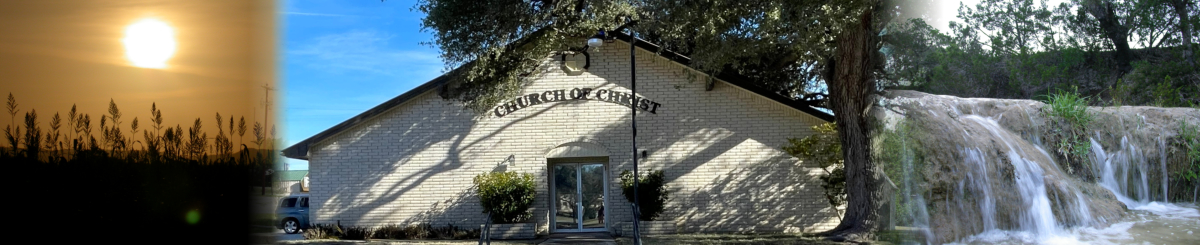
At the Leakey Church of Christ we believe that Jesus Christ is the Son of the only true and Living GOD, and that He came to this earth to give His life so that all could have the chance to be saved from sin. John 3:16-17
The Leakey Church of Christ is a congregation of Christians who follow the teaching of Christ, and His apostles as seen within the New Testament.
Do You Know Jesus?
Matthew 16:15-18 He said to them, "But who do you say that I am?" Simon Peter answered, "You are the Christ, the Son of the living God." And Jesus said to him, "Blessed are you, Simon Barjona, because flesh and blood did not reveal this to you, but My Father who is in heaven. I also say to you that you are Peter, and upon this rock I will build My church; and the gates of Hades will not overpower it."
Jesus asked His disciples who they believed He was. Peter spoke up and said,
“Jesus was the Christ the Son of the living GOD." It was from that rock solid, foundational, statement of faith, which Peter proclaimed, that Jesus built His Church upon.
When Jesus gave his life upon the cross, in order to make atonement for sin, and after He arose from the grave, He told His disciples to go and tell the world the Gospel, GOD's plan of salvation.
"Matthew 20:28; Mark 16:15-16; 1 Timothy 2:1-6''
We see this beginning first within the book of Acts chapter two, where Peter is speaking to the Jewish people on the Day of Pentecost. Peter by the inspiration of the Holy Spirit said to the people, "Repent, and each of you be baptized in the name of Jesus Christ for the forgiveness of your sins; and you will receive the gift of t11e Holy Spirit. "For the promise is for you and your children and for all who are far off, as many as tile Lord our God will call to Himself." And with many other words he solemnly testified and kept on exhorting them, saying, 'me saved from this perverse generation!" Acts 2:38-40.
On the very first day that GOD' s Gospel plan of salvation was preached, the Church of Christ began, and grew to around 3,000 souls.
From there as we see from the book of Acts, the LORD continued to save lost souls, and the Church began to be built, and grow. Even today we are able to see GOD' s Gospel plan of salvation working within the lives of many, saving them from sin and death.
• First We Must Hear and Be Taught the Word of GOD: Romans 10:17; John 6:45
• We Must Believe in Christ: John 3:16
• We Must Obey Christ: John 3:35-36; Romans 2:13
• We Must Repent of our Sins: Luke 13:3; Luke 5:32
• We Must Confess Jesus As LORD: Romans 10:10-11
• We Must Be Baptized: Acts 2:37-40; Acts 22:16; 1 Peter 3:21
• We Must Live Faithful Until Death: Revelation 2:10; Hebrews 11
Here at the Leakey Church of Christ we offer Bible studies to anyone who would like to study GOO's Word. We go only by the Bible and it's teaching, because we believe, and know GOD has given us all that we need for life and godliness.
1 Peter 1:3-8 seeing that His divine power has granted to us everything pertaining to life and godliness, through the true knowledge of Him who called us by His own glory and excellence. For by these He has granted to us His precious and magnificent promise, so that by them you may become partakers of the divine nature, having escaped the corruption that is in the world by lust. Now for this very reason also, applying all diligence, in your faith supply moral excellence, and in your moral excellence, knowledge, and in your knowledge, self-control, and in your self-control, perseverance, and in your perseverance, godliness, and in your godliness, brotherly kindness, and in your brotherly kindness, love. For if these qualities are yours and are increasing, they render you neither useless nor unfruitful in the true knowledge of our Lord Jesus Christ.
Matthew 11:28-30
"Come to Me, all who are weary and heavy-laden, and I will give you rest. "Take My yoke upon you and learn from Me, for I am gentle and humble in heart, and you will find rest for your souls. "For My yoke is easy and My burden is light."
Sunday morning Bible class – 10:00 a.m.
Sunday morning worship – 10:45 a.m.
Sunday evening worship – 5:00 p.m.
Wednesday evening Bible study – 5:00 p.m.